
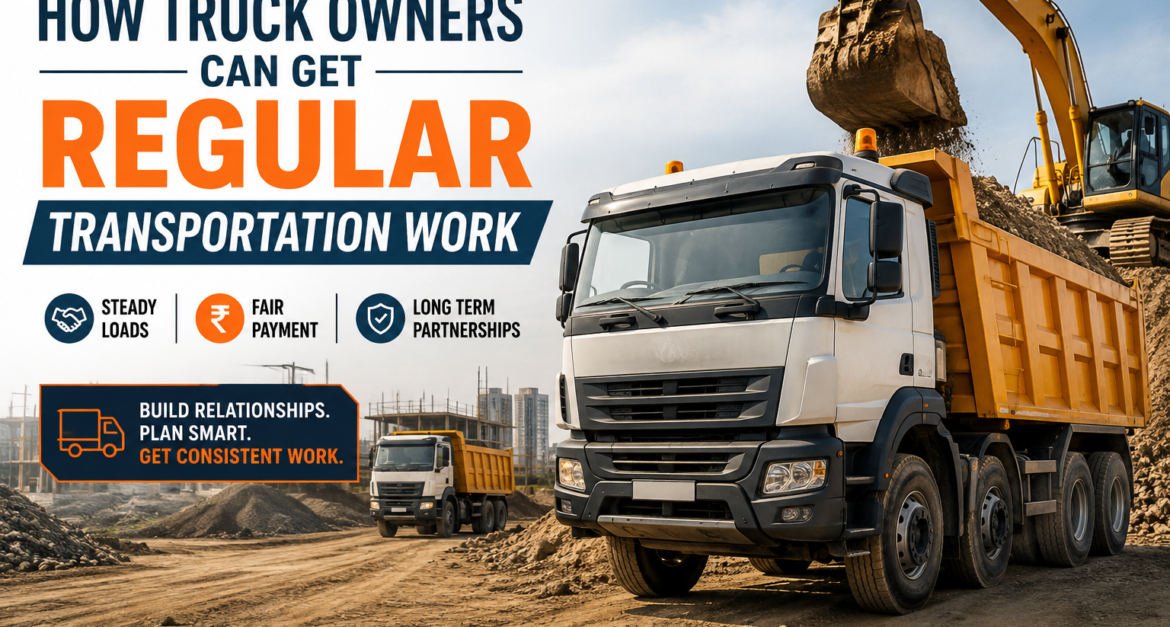
If you own a truck or a dumper, you already know the real challenge isn’t driving, it’s finding work that doesn’t stop. An idle truck earns nothing while EMIs, insurance, and driver salaries keep adding up. The good news is that regular transportation work isn’t about luck. It comes down to a few practices that experienced truck owners follow consistently building the right relationships, understanding how freight pricing works, keeping your vehicle and paperwork in order, and choosing the right partners to work with. This guide breaks down exactly how truck owners can get regular transportation work in India, along with the mistakes that keep many owners stuck with inconsistent bookings.
Table of Contents
Why Consistent Work Matters More Than One-Off Trips
A single high-paying trip feels good, but it doesn’t pay the bills every month. Owner-operators who build a stable income tend to prioritise repeat work over one-time bookings, because predictable freight volume makes it far easier to plan fuel, maintenance, and driver costs in advance. The same principle applies directly to Indian truck and dumper owners regular loads, even at slightly lower per-trip margins, usually beat sporadic high-value trips with long idle gaps in between.
1. Understand How Freight and Trip Pricing Works
Before you can negotiate regular work, you need to know what a fair rate actually looks like. Truck transportation charges in India are built from two components: fixed costs like vehicle EMI, insurance, permits, and driver salary, and variable costs like diesel, tyres, tolls, and loading or unloading labour. On top of these, transporters typically add a margin of around 10 to 20%, which shifts depending on route demand and truck availability.
Rates also change by distance and season. Short regional runs price very differently from long interstate corridors, and freight rates on busy routes tend to run noticeably lower than on remote or low-traffic ones because trucks can more easily find a return load. Understanding this structure helps you spot underpriced work early, negotiate confidently, and avoid trips that leave you running at a loss once fuel and detention charges are accounted for.
2. Build Long-Term Contracts Instead of Chasing Single Loads
The single biggest shift that moves a truck owner from unpredictable income to steady income is signing on for repeat, longer-term work rather than one trip at a time. This can mean:
- Partnering with construction companies for ongoing material transport (sand, stone, soil, cement).
- Working with manufacturers, wholesalers, or industrial suppliers who need regular dispatch.
- Registering with a transport coordinator who allocates loads based on your truck type and location, instead of relying on word-of-mouth alone.
Long-term relationships with a small number of reliable partners almost always outperform constantly hunting for the next single booking. It means less time idle and more time earning.
3. Keep Your Truck Load-Ready at All Times
Regular work only comes to trucks that are actually fit to take it. Timely maintenance, including oil changes, tyre checks, and brake inspections, keeps your vehicle compliant and reduces the risk of breakdowns that cost you both money and reputation with the people who give you work. Owners who treat maintenance as routine, rather than reactive, are far more likely to be offered repeat loads because coordinators and companies remember which trucks show up on time, every time.
4. Match Your Truck Type to Consistent Demand
Not every truck configuration gets the same volume of work. In India, loads are commonly available for 10, 12, 14, 16, 18, and 22 tyre trucks and dumpers, and knowing which categories are in demand in your operating region helps you position your vehicle correctly. If you’re open to handling multiple cargo types, such as construction material, stone, sand, soil, or industrial goods, you widen the pool of regular work available to you instead of waiting for one specific type of load.
5. Choose Full Truck Load or Part Load Based on Your Route
Full Truck Load (FTL) work means you carry a single consignment for one client, priced as a trip rate. It works best when you can consistently fill 60% or more of your capacity. Part Truck Load (PTL) work, where multiple smaller shipments are combined in a single trip, can be a smart way to avoid running empty when full loads aren’t available on a given route. Owners who stay flexible between FTL and PTL, depending on the corridor and season, keep their trucks moving more consistently than those who wait exclusively for full loads.
6. Work With Transparent, Trusted Coordinators
A major reason many truck owners struggle with irregular work isn’t a lack of demand, it’s working through unreliable middlemen with unclear payment terms. Look for transport partners who are upfront about:
- How loads are assigned and how quickly you’re informed.
- Payment timelines and terms, agreed before the trip starts.
- Support for loading, unloading, and warehousing coordination.
Transparent communication and fair, on-time payment are what turn a one-time booking into a repeat relationship. Truck owners consistently report that this, more than rate alone, is what keeps them coming back to the same coordinator.
7. Use Digital Tools and Instant Updates
Route planning, digital documentation, and real-time updates all reduce wasted time and missed opportunities. Even something as simple as joining a WhatsApp channel for load alerts can mean you hear about available work before a competing truck does. Owners who stay reachable and responsive to load updates get first access to the trips that come up on short notice, which is often where the best regular work is won or lost.
How Truck Owners Can Get Regular Transportation Work with Dumper Transport
This is exactly the gap Dumper Transport is built to close. Operating pan-India with over 10 years of experience, Dumper Transport connects truck and dumper owners, across 10, 12, 14, 16, 18, and 22 tyre categories, with regular loads of construction material, stone, sand, soil, and industrial goods.
Instead of owners chasing scattered one-off trips, Dumper Transport focuses on long-term, repeat work with transparent communication, on-time payments, and support for loading, unloading, and warehousing coordination. Updates and load information are shared directly over call and WhatsApp, so registered truck owners are among the first to know when work is available in their area.
If you’re a truck or dumper owner looking to stop your vehicle from sitting idle, registering with a coordinator built around these principles is one of the fastest ways to move from unpredictable bookings to consistent, stress-free earnings.
Conclusion
Getting regular transportation work as a truck or dumper owner isn’t about one clever trick. It’s the combination of a well-maintained vehicle, the right partnerships, flexible load choices, and transparent, dependable communication. Owners who focus on these fundamentals consistently spend less time idle and more time earning. If you’re asking how truck owners can get regular transportation work in India, start with these habits and choose a coordinator who supports them.
Register With Dumper Transport Today
Looking for consistent truck or dumper work across India? Register with Dumper Transport to get regular loads, on-time coordination, and long-term support.
How can a truck owner get regular transportation work in India?
By building long-term relationships with businesses or transport coordinators, keeping the vehicle well maintained and compliant, staying flexible between FTL and PTL loads, and working with partners who offer transparent terms and timely payments.
What truck types get the most regular loads?
In India, demand is fairly consistent across 10, 12, 14, 16, 18, and 22 tyre trucks and dumpers, though availability can vary by region and season. Staying open to more than one cargo type increases your chances of steady work.
Is it better to rely on one client or multiple transport partners?
A mix works best for most owners one or two dependable, long-term partners for a base level of regular work, supplemented by additional load sources so the truck isn’t dependent on a single relationship.
Does payment reliability really affect how much work a truck owner gets?
Yes. Coordinators and clients who pay on time and communicate clearly tend to retain the same truck owners for repeat work, while unclear or delayed payment terms are one of the most common reasons owners stop working with a partner.